
Criminal Court Cases in Plaquemines
The Twenty-Fifth Judicial District Court Clerk holds the local criminal case record. The judicial district is coterminous with Plaquemines Parish, so its boundary matches the parish. This court of general jurisdiction hears felonies, misdemeanors, traffic and DWI matters, wildlife violations, juvenile matters, and Adult Drug Court proceedings. It has Division A and Division B. There is no incorporated-city municipal court layer and no city clerk keeping a separate criminal docket.
The case file differs from the arrest report and booking entry. It centers on a docket number, division, charging instrument, pleadings, minute entries, hearings, judgment, costs, and sentence. An initial booking charge is only an allegation. The district attorney may file a different count, amend it, or decline it. For that reason, the court record is the best local source for the filed prosecution and final disposition.
The Clerk’s official homepage brings the local court tools together. The Clerk portal shown here links users to eSearch, electronic filing, the calendar, forms, and expungement help.
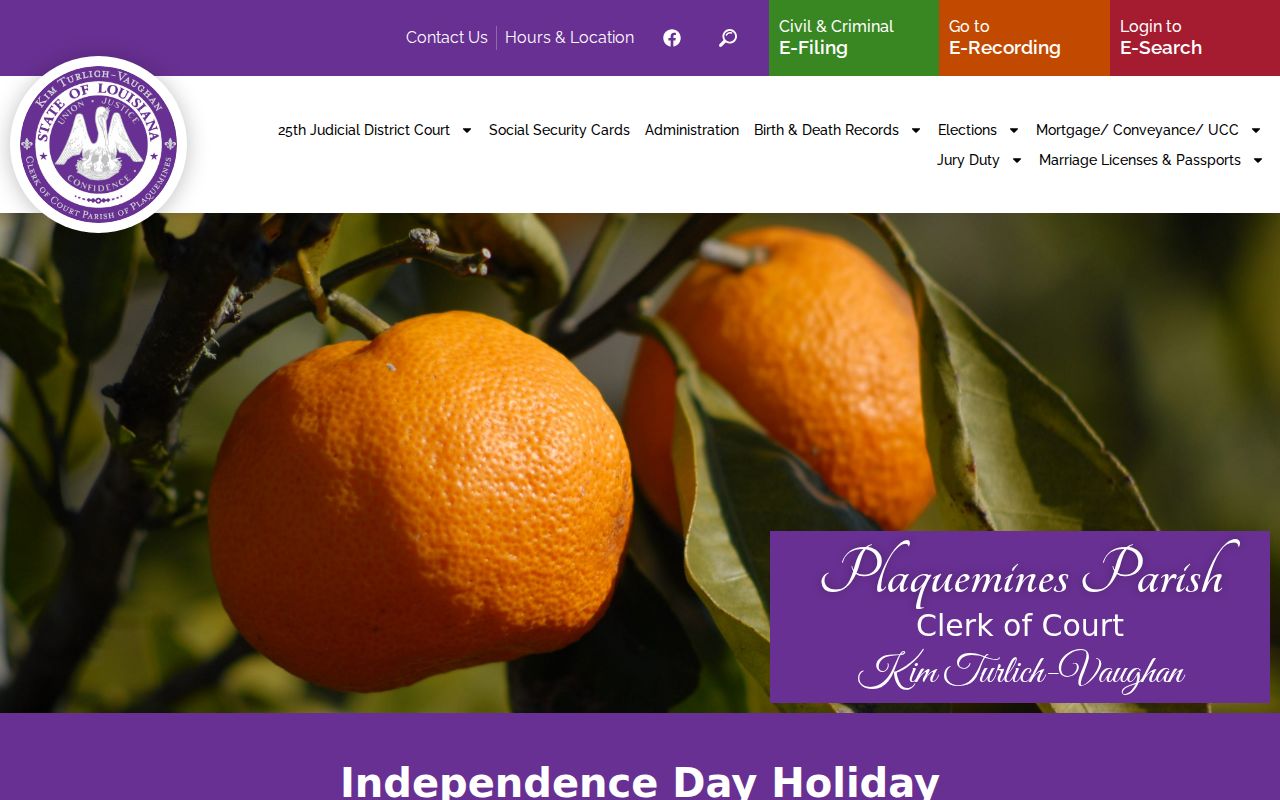
Those links lead to distinct services, and no single one replaces the official case file maintained by the Clerk.
Plaquemines Court Cases by Division
Division A and Division B share general criminal jurisdiction. Division A is led by Chief Judge Kevin D. Conner and can be reached at 504-934-6715. Division B is led by Judge Michael D. Clement and can be reached at 504-934-6730. Both judicial offices are on the second floor of the Pointe-à-la-Hache courthouse. Appeals from the district court go to Louisiana’s Fourth Circuit.
The division is more than a label. It directs a reader to the right calendar setting and judicial office. The case number and division should be recorded together during a Plaquemines Parish criminal case search. That pair is more reliable than a name alone, especially when people share similar names.
Note: The Belle Chasse Annex is a Clerk records counter, not a second criminal trial court or a municipal court.
Plaquemines Parish Case Record Searches
The Clerk uses Cott Systems eSearch for remote discovery. Criminal indexing begins January 4, 1966, while available criminal document images begin September 6, 2006. A guest account is free but exposes index information only. It does not provide criminal docket data or document images. Paid criminal access is required for those layers, and the online copy remains unofficial.
- Open the Clerk-linked Cott eSearch and use guest access to locate an index entry.
- Search with the party name or case number, then confirm the division and filing details.
- Buy criminal access if docket entries or available images are needed.
- Check the official court calendar only for a future setting, not as proof of outcome.
- Request an official or certified disposition from the Clerk when the result must be authoritative.
| Field Label | Type | Required | Use |
|---|---|---|---|
| Party name | Text | No | Starts a name-based index search |
| Case number | Text | No | Best way to isolate a known docket |
| Division | Case detail | No | Confirms Division A or Division B |
| Filing date | Date | No | Helps separate similar entries |
| Certified date | Date | No | Should be checked before relying on an image |
The official Cott eSearch login shown here displays its guest route, coverage, prices, and access warnings.
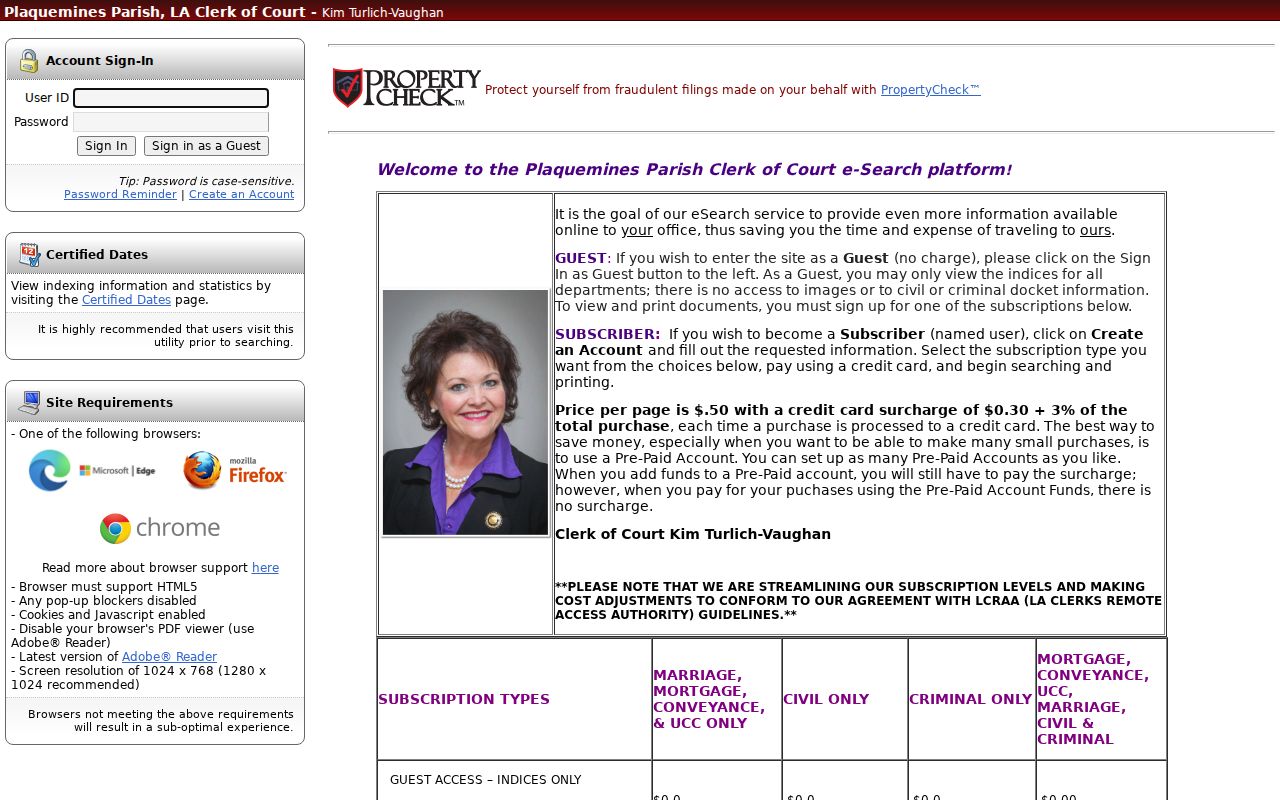
The login screen matters because it makes the free index and paid criminal docket tiers visibly distinct.
Plaquemines Criminal Index Access
Paid access costs $20 for 24 hours, $75 for 30 days, or $200 for a criminal-only annual plan. A combined annual plan costs $650. Document images cost $0.50 per page, and card payments add $0.30 plus 3 percent. These fees buy remote access, not certification. A printed portal image should not be described as an official certified disposition.
Coverage dates also shape the fallback. An indexed case from before September 2006 may have no remote image even though the Clerk holds the underlying record. A newer file can also be incomplete online. In either situation, contact the Clerk at 504-934-6610 or info@clerk25th.com. Requests for searches and copies may use the Clerk’s Service Request/Credit Card Authorization form by email or may be made at either counter.
What a Criminal Case File Contains
A Plaquemines Parish criminal case file follows the prosecution rather than the jail stay. It shows the formal accusation, court events, filed motions, and the outcome for each count. Searchers should match the case number, person, division, and charge before attributing an entry. The most useful fields depend on the question, but the disposition and judgment usually carry more weight than an early calendar line.
| Case Number & Court | Identifies the 25th JDC docket and assigned division. |
|---|---|
| Charging Document | Shows the bill of information, indictment, or other filed accusation. |
| Docket Entries | Chronologically records filings, motions, minute entries, and court activity. |
| Hearing Dates | Lists settings such as arraignment, motion hearings, trial, and sentencing. |
| Disposition & Judgment | States whether a charge ended in conviction, dismissal, acquittal, or another result. |
| Sentence & Conditions | Records punishment, supervision, costs, restitution, and court-ordered terms when applicable. |
A minute entry is the Clerk’s short record of what occurred in court. It should be read with later entries because a hearing setting may move, a plea may resolve only some counts, and the sentence may appear on a later date.
Official Plaquemines Court Case Copies
The Clerk serves two physical locations. Court proceedings take place at 18055 Highway 15 in Pointe-à-la-Hache. The Belle Chasse Annex at 301 Main Street, Suite 108, provides a records counter and is the correspondence address listed by the Clerk. Both routes lead to the same parish court custodian. A reader requesting proof should identify the docket, division, and exact document or disposition needed.
The Clerk’s hours and locations page shown here distinguishes the courthouse from the annex.
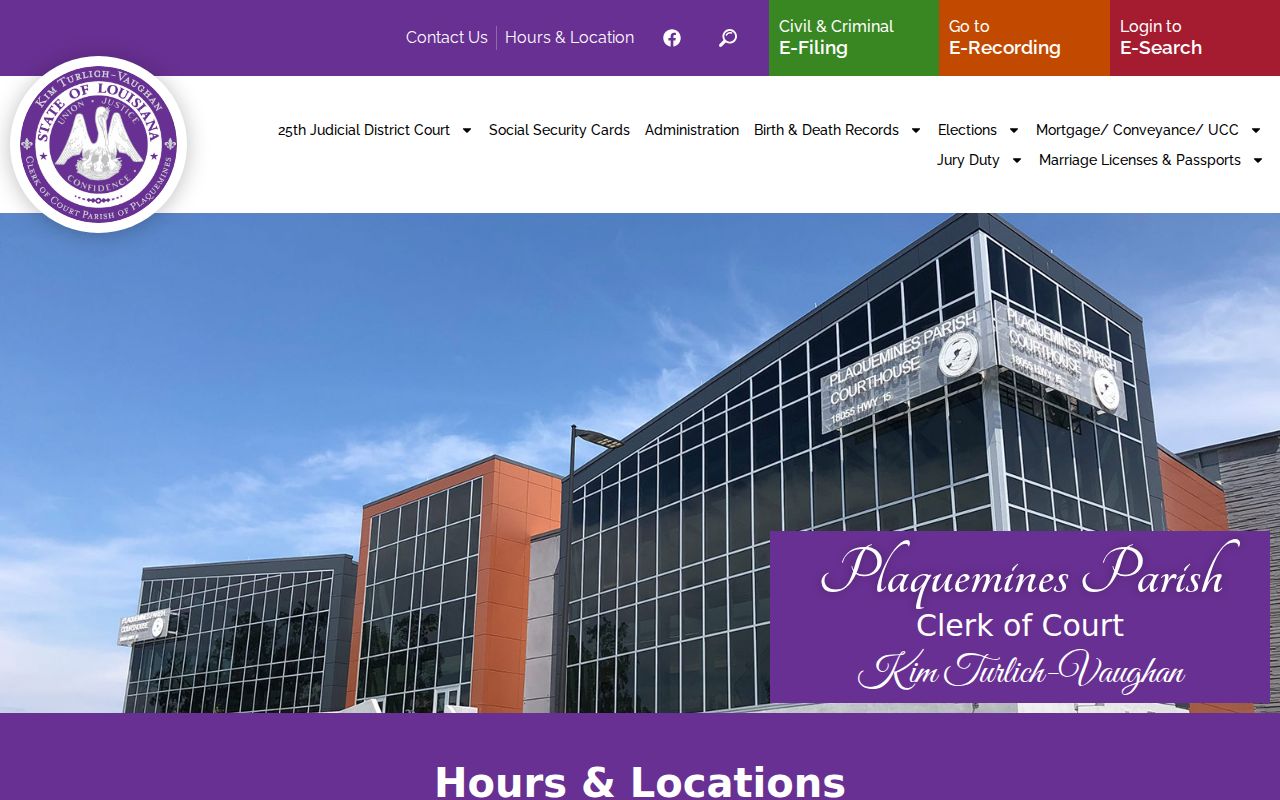
That distinction can prevent a trip to the records counter when the reader intends to attend a hearing at the courthouse.
Fax filing ended December 31, 2025. The court emphasizes electronic filing, signatures, and digital imaging. Its paperless strategy protects case records from theft, manipulation, fire, flood, and other disasters, a practical concern in hurricane-exposed Plaquemines Parish.
Criminal Case Stages in Plaquemines
A Louisiana prosecution usually begins with an arrest and initial appearance or bail decision, followed by prosecutorial screening. The district attorney may file a bill of information or seek an indictment. Arraignment is the hearing where the accused is told the formal charge and enters a plea. Discovery and motions follow, then a plea or trial, disposition, sentence, and possible appeal.
Case flow: Charges Filed › Arraignment › Pretrial › Plea or Trial › Disposition › Sentencing
An arrest charge can change at screening. A bill of information is the prosecutor-filed accusation used where permitted, while an indictment is a grand jury’s formal felony accusation. The filed instrument, not the roster label, defines what the court was asked to decide.
Note: A court calendar shows planned activity, while the later docket and certified disposition show what actually occurred.
Plaquemines Court Calendar Limits
The 25th JDC court calendar shown here supports searches for division and event schedules.
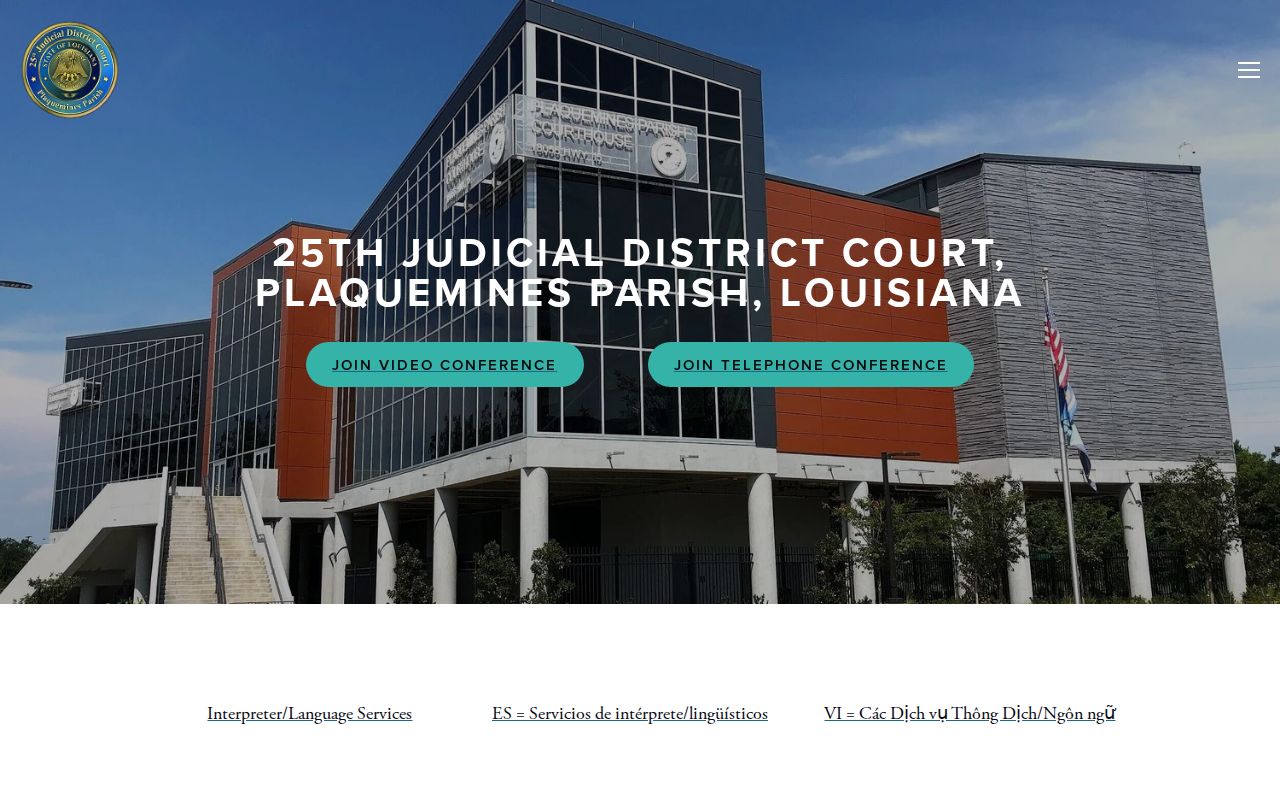
The interface is useful for confirming where and when a matter is set. It is not a disposition database. A listed hearing can be continued, canceled, or followed by later action that only the docket reflects.
- Nolle prosequi
- The prosecutor’s formal choice not to continue a charge at that time.
- Dismissal
- The termination of a charge by prosecutorial or court action.
- Acquittal
- A not-guilty determination after the matter is decided.
- Conviction
- A judgment of guilt following a guilty plea or verdict.
These results are not interchangeable. A missing calendar setting does not prove dismissal, and a nolle prosequi is not an acquittal. Read the charge-level disposition in the case record.
Access Rules for Case Records
Louisiana public access depends on the custodian and the record. Ordinary court files are requested from the Clerk. Louisiana computerized criminal history, by contrast, is restricted under La. R.S. 15:587 and is not an anonymous public people-search system. A person reviewing their own fingerprint-linked statewide history uses the Louisiana State Police BCII Right to Review process. These channels answer different questions.
Juvenile records, protected victim details, active-investigation material, and expunged or sealed cases can be withheld or redacted. An absent online result does not prove that no file exists. Ask the Clerk whether the matter falls outside remote coverage or has restricted access. If part of a public record is exempt, a requester may ask for the segregable public portion.
A red “In Progress” eSearch entry may mean information has not yet been released through the portal. It is not a final result. Portal warnings also advise users to check certified dates. For legal proof or correction of a missing disposition on a state history, obtain an original, unaltered certified disposition from the Clerk.
Plaquemines Expungement Case Records
Louisiana expungement removes qualifying records from normal public access but does not destroy every agency copy. A Plaquemines filing ordinarily goes through the 25th JDC Clerk because that is where the arrest and prosecution record sits. The packet must match the original booked charges, all counts, arrest date, court outcome, and agency identifiers. Missing a certified disposition or using only an amended charge can delay the process.
The court-linked Plaquemines expungement page shown here provides the local checklist, forms, and filing procedure.
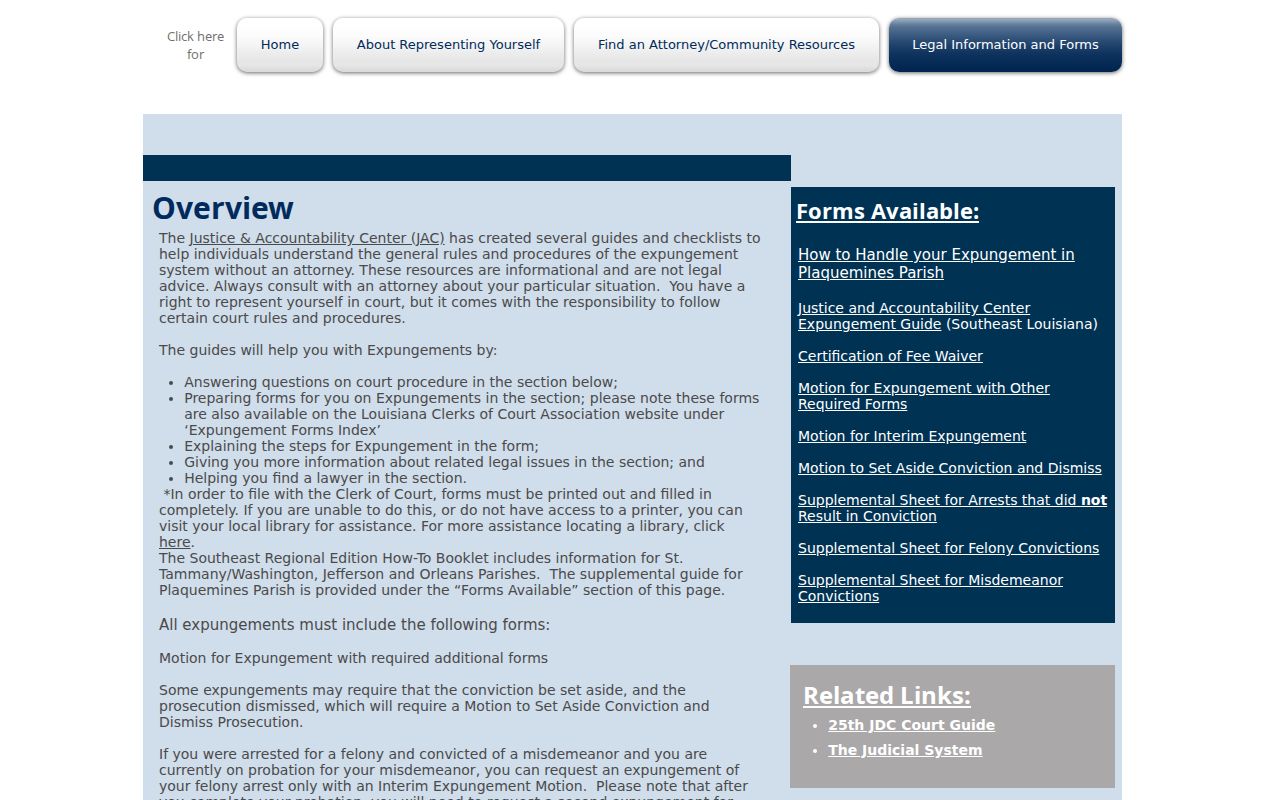
The checklist ties relief to the real court file, which is why a certified disposition is central to both filing and later correction work.
After an order is signed, each named agency must receive it. Authorized agencies may retain access, and third-party copies may lag. A later BCII Right to Review and a check of the Clerk’s public view can help confirm that the official systems reflect the order.